
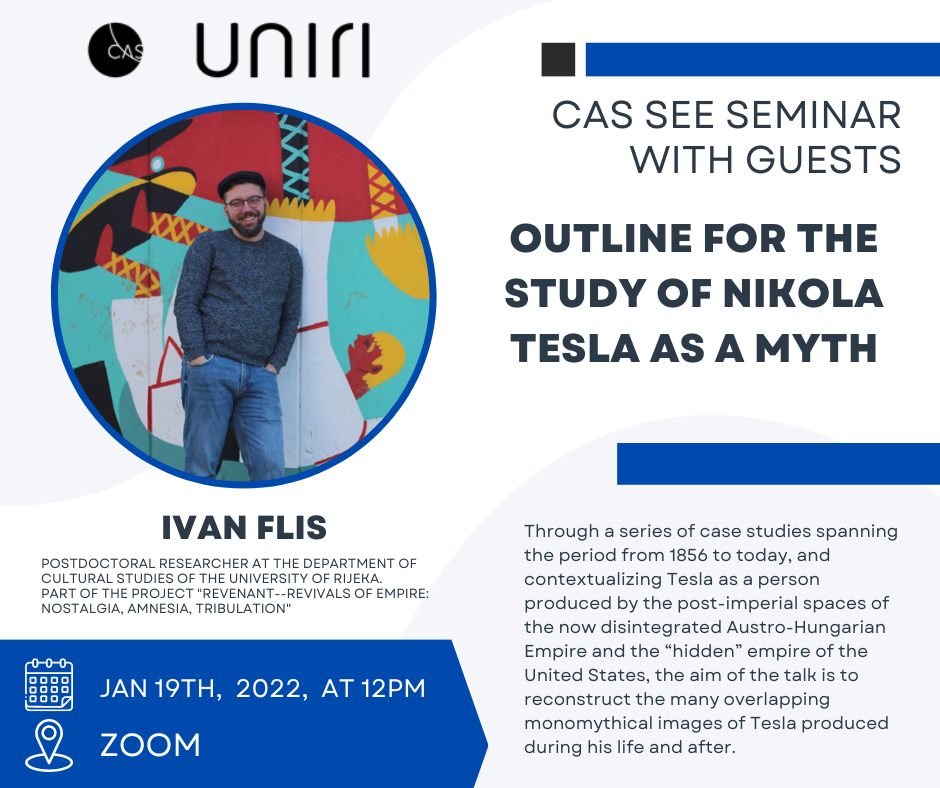
CAS SEE Seminars with Guests: Ivan Flis
Author(s): Ivan Flis Thematic Area: Social Criticism Published: 2023 Language: English Tags: video | More DetailsThe celebrated inventor Nikola Tesla was born in 1856 in Smiljan and died in 1943 in New York. Smiljan and Lika, at the time, were part of the Austro-Hungarian Military Frontier in what is today Croatia. Tesla, an ethnic Serb whose father was a protopresbyter (Orthodox priest), left the Military Frontier as a young man; first for Graz, and then to Prague, Budapest, Paris, Strasbourg, and finally New York.
In the US, Tesla made his name as an inventor in the newly developing field of electric engineering, by the turn of the century emerging as one of the de facto leaders of the so called “War of the Currents” on the side opposite to the “Wizard of Menlo Park”, Thomas Alva Edison. Later in life, Tesla struggled to finance his research and died a penniless old man in 1943.
Tesla’s story was told and retold numerous times in different ways – academic, popular, fictional, educational, nationalist, hagiographic, countercultural – with his cultural impact often described as everything from “Tesla who was unjustly ignored” to “Tesla who was the most important genius launching the modern age”.
In this talk, Flis will propose an outline for the study of the memory and legacy of Nikola Tesla. Through a series of case studies spanning the period from 1856 to today, and contextualizing Tesla as a person produced by the post-imperial (Walton, 2021) spaces of the now disintegrated Austro-Hungarian Empire and the “hidden” empire of the United States (Immerwhar, 2019), his aim is to reconstruct the many overlapping monomythical images of Tesla produced during his life and after.
Tesla the Inventor, Tesla the Serb, Tesla the Emigrant, Tesla the Immigrant, Tesla the Croatian, Tesla the Yugoslav, Tesla the Genius, Tesla the Humanitarian, Tesla the American, Tesla the Scientist, Tesla the New Yorker, Tesla the Forgotten, Tesla the Eccentric; all these images of Tesla are overlapping traces of the evolution of a culture hero (Wachhorst, 1981). Some were initially produced and maintained by Tesla himself, but then reconfigured by numerous scientific, professional, national, and religious communities claiming his legacy and memory.
Back