
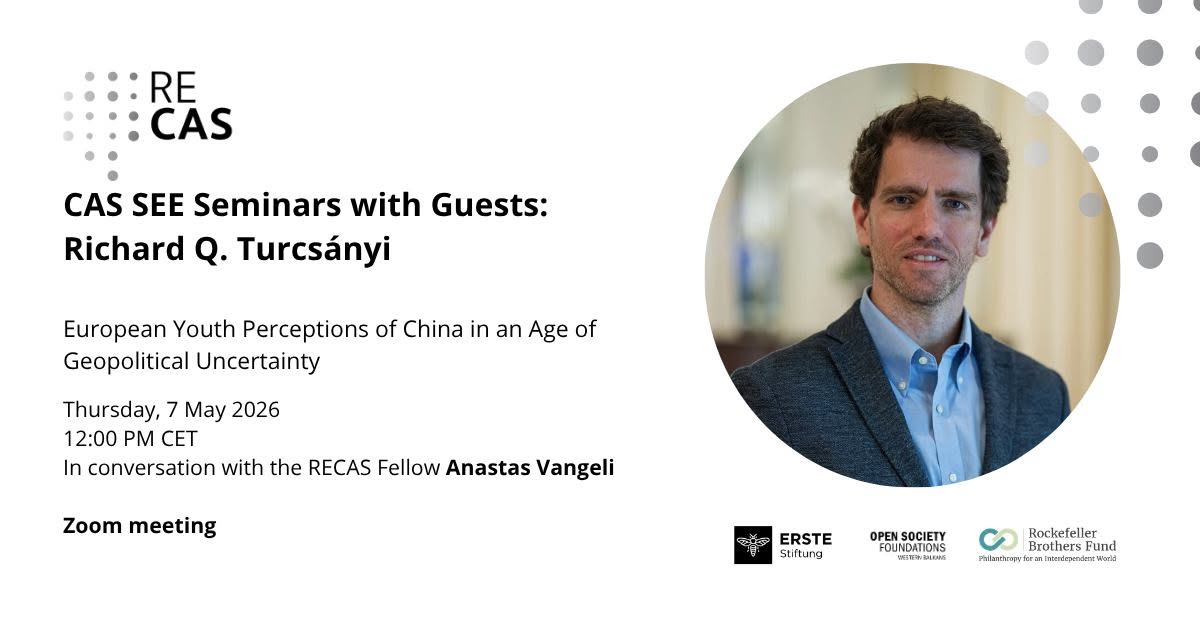
CAS SEE Seminars with Guests: Richard Q. Turcsányi
Author(s): Anastas Vangeli , Richard Q. Turcsányi Thematic Area: Education Published: 2026 Tags: video | More DetailsBuilding on original survey data collected across multiple European countries, this discussion examines how younger generations in Europe perceive China and how these perceptions differ from those of older cohorts. While public and policy debates on China are often dominated by concerns over strategic rivalry, economic security, technological dependence, and geopolitical tensions, younger Europeans frequently encounter China through a different set of channels: digital culture, consumer trends, education, mobility, and everyday online interactions.
The talk will explore how these generational differences shape broader societal understandings of China, asking whether Europe is witnessing the emergence of new cognitive and cultural maps that diverge from established political narratives. Particular attention will be paid to the impact of recent global disruptions—including the pandemic, the war in Ukraine, intensifying US-China rivalry, and Europe’s own debates on de-risking and strategic autonomy—on youth attitudes toward China.
At the same time, the discussion will move beyond traditional diplomacy and official narratives to examine novel forms of China’s image projection abroad. From the global popularity of Chinese consumer products and pop-cultural phenomena such as Labubu dolls, to digital subcultures and social media trends like “Chinamaxxing,” younger generations increasingly engage with China through informal, decentralized, and often ironic or ambivalent channels. These encounters complicate simplistic binaries of attraction versus threat, revealing a much more layered landscape of perception.
Situated within the broader framework of the RECAS project and its focus on normative encounters and competing imaginaries of the future, the talk will reflect on what these developments reveal about Europe’s own uncertainties, aspirations, and ideological struggles. Are younger Europeans becoming more open to alternative models of modernity and development, or are these merely surface-level cultural fascinations detached from political and economic realities?
The session will conclude by considering the broader implications for Europe’s future: how shifting perceptions of China among younger generations may influence policymaking, public discourse, higher education cooperation, and Europe’s own strategic positioning in a world increasingly shaped by competing centers of power and imagination.
Back